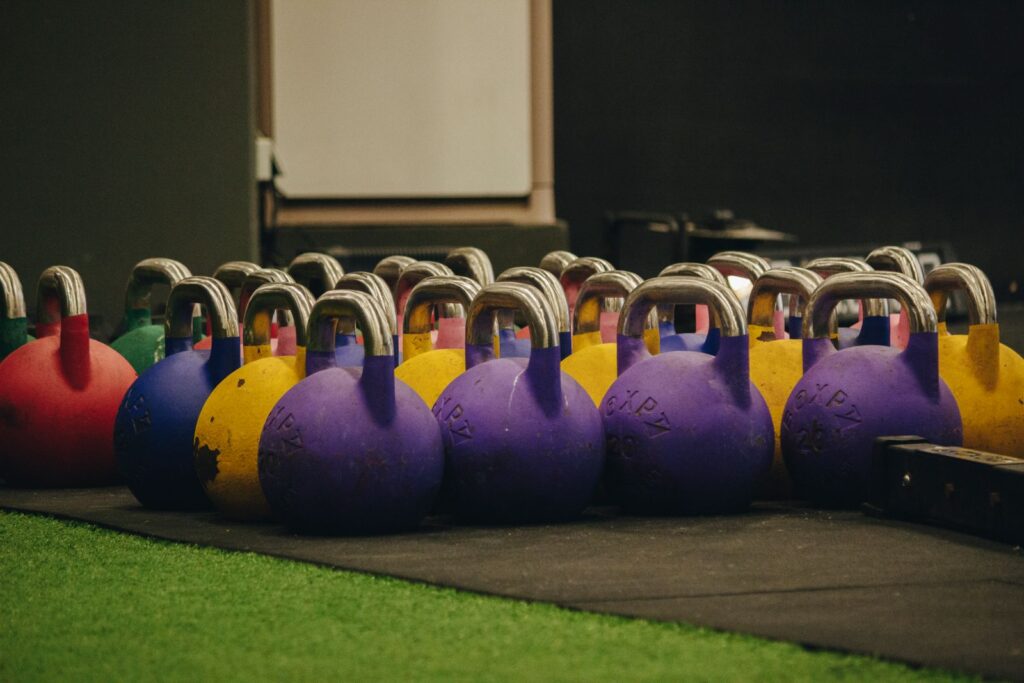
“Functional training” gets used loosely in gyms — sometimes to describe kettlebells, sometimes balance boards, sometimes just any exercise that isn’t a traditional machine. The underlying idea is more specific: training that carries over to real movements you actually perform in daily life or sport, rather than isolating single muscles in fixed positions.

What Makes Training “Functional”
Functional exercises tend to train multiple muscle groups together in patterns that resemble real-world movement: squatting to pick something up, carrying a heavy bag, pushing a door open, twisting to reach behind you, or catching your balance on uneven ground. These movements often involve multiple joints, some degree of balance or stabilization, and coordination between muscle groups working together, rather than a single muscle moving through a fixed, supported path like a seated leg extension machine.
Common Functional Training Elements
- Loaded carries: farmer’s walks and similar exercises that train grip, core stability, and posture under load while walking
- Single-leg work: lunges, step-ups, and single-leg deadlifts that train balance and unilateral strength, closer to how legs work individually during walking or running
- Rotational and anti-rotational movements: wood chops, Pallof presses, and similar exercises that train the core’s role in resisting or producing rotation, relevant to many sports and daily twisting movements
- Multi-joint compound lifts: squats, deadlifts, and overhead presses, which train coordinated movement across several joints simultaneously
Who Benefits Most
Functional training principles tend to be particularly relevant for older adults working to maintain independence and fall resistance, athletes whose sports demand coordinated, multi-directional movement, and people recovering from injury who need to rebuild coordinated movement patterns rather than isolated muscle strength alone. That said, isolated, machine-based strength training still has genuine value, particularly for building foundational strength, rehabilitating a specific weak area, or simply working around joint limitations that make more complex movements uncomfortable.
A Balanced Approach
Functional training isn’t inherently superior to traditional strength training, and the two aren’t mutually exclusive. A well-rounded program often includes both: foundational strength work (compound lifts, some isolation work for specific weak points) alongside movements that build coordination, balance, and multi-planar strength relevant to daily activities or a specific sport.
Frequently Asked Questions
Is functional training better than traditional weightlifting? Neither is universally better; functional training emphasizes movement patterns and coordination relevant to daily life or sport, while traditional lifting is often more effective for building maximal strength in a controlled way. Many programs combine both.
Do I need special equipment for functional training? No — while kettlebells, sandbags, and balance tools are common, many functional patterns (carries, single-leg work, rotational movements) can be trained with dumbbells, resistance bands, or even bodyweight alone.
What Makes a Strength Exercise “Functional”
Functional strength training refers to exercises that train movement patterns your body actually uses in daily life and sport, squatting, hinging at the hips, pushing, pulling, carrying, rotating, rather than isolating a single muscle in a fixed, machine-guided path. The distinction isn’t about which exercises are “real” strength training, machine-based isolation exercises build genuine strength too, it’s about carryover: functional training emphasizes multi-joint, often multi-planar movements that more closely mirror how your body moves outside the gym, which proponents argue produces strength and stability that transfers more directly to everyday tasks and reduces injury risk during unplanned, real-world movements.
A classic example of the distinction: a leg extension machine trains knee extension in isolation, which does build quad strength, but a goblet squat trains your quads, glutes, core, and stabilizing muscles together in a pattern that closely resembles standing up from a chair or lifting an object from the floor, arguably giving it more direct “functional” carryover to daily movement.
What the Evidence Actually Shows
Research generally supports the core premise: multi-joint, movement-pattern-based training does improve balance, coordination, and functional capacity, particularly in older adults, where functional strength training has shown meaningful reductions in fall risk and improvements in the ability to perform daily activities independently. For general population fitness and injury prevention, functional training’s emphasis on core stability, balance, and multi-planar movement (moving forward-back, side-to-side, and rotationally, not just in straight lines like most traditional gym machines) addresses movement qualities that pure isolation training often neglects.
Where the marketing sometimes overstates things is implying that functional training is inherently superior to all other training for every goal, for pure muscle size or maximum strength in a specific lift, more traditional, controlled resistance training, including some isolation work, remains highly effective and is often more efficient for those specific goals.
Building It Into a Routine
Practically, functional strength training often centers on foundational movement patterns: squats and lunges (lower body push patterns), deadlifts and hip hinges (posterior chain), presses (upper body push), rows and pull-ups (upper body pull), and carries or rotational core work. These can be trained with barbells, dumbbells, kettlebells, resistance bands, or bodyweight, the equipment matters less than training the movement pattern itself through a full, controlled range of motion. Most well-designed strength programs, whether explicitly labeled “functional” or not, already incorporate these patterns, which is worth knowing if you’re deciding whether you need a separate specialized program versus simply making sure your current routine covers these fundamental movements.
Balance and single-leg stability work, often included in functional programs but sometimes skipped in traditional bodybuilding-style routines, has particularly strong evidence for reducing fall and injury risk in older adults, making it a worthwhile addition regardless of your primary training goal.
Sources
- National Strength and Conditioning Association — Functional Training Resources
- American College of Sports Medicine — Resistance Training Guidelines
- American College of Sports Medicine
- National Institute on Aging (NIH)
Final Thoughts
Functional training is less about specific equipment and more about a training philosophy: prioritizing movement patterns that transfer to real life. Combined with foundational strength work, it can round out a program in ways that isolated machine work alone doesn’t cover.
This article is for general educational purposes and is not a substitute for personalized medical or fitness advice.
About the Author
This article was written and reviewed by Ethan Brooks, focused on translating public health information into clear, practical guidance for everyday readers. If you spot an error or have a correction, please contact us.