Anyone who has taken a break from exercise and gone back too hard knows the feeling: a day or two later, stairs become a challenge and sitting down requires planning. That soreness has a name, delayed onset muscle soreness, usually shortened to DOMS, and despite how common it is, there is still a lot of confusion about what it actually means and whether it is something to chase or something to avoid.
What Is Actually Happening in the Muscle
DOMS is most closely linked to eccentric muscle contractions, the lengthening phase of a movement, like lowering into a squat or the downward part of a bicep curl. These movements create small amounts of microscopic damage in the muscle fibers, which triggers an inflammatory response as the body repairs the tissue. That repair process is part of what leads to the muscle adapting and, over time, getting stronger and more resilient to that same type of stress.
The soreness itself typically shows up 24 to 48 hours after exercise, peaks somewhere in that window, and then fades over the following few days. This delay is exactly why it is called delayed onset, as opposed to the more immediate burning sensation felt during a hard set, which is a different physiological process related to metabolic byproducts rather than muscle damage.
Is Soreness a Sign of a Good Workout
A common belief is that if a workout does not produce soreness, it was not effective. This is not accurate. Soreness tends to be most intense after a new movement, a long layoff, or an unusually high amount of eccentric loading, not necessarily after the most productive or well-programmed workout. Someone who trains consistently often experiences far less soreness over time, even while continuing to make progress, because the body adapts to the specific stress it repeatedly encounters, a phenomenon sometimes called the repeated bout effect.
In other words, an experienced lifter who rarely feels sore is not necessarily training less effectively than someone who is sore after every session. Soreness is a byproduct of unfamiliar or unusually intense stress, not a required ingredient for building strength or muscle.
Training Through Soreness

Mild to moderate soreness generally does not require stopping exercise altogether. Light movement, walking, easy cycling, or a lower-intensity version of the same workout, often helps by increasing blood flow to the affected muscles, which can ease stiffness. Training through mild soreness at reduced intensity is usually fine and sometimes even helpful for recovery.
Severe soreness that significantly limits range of motion or basic daily movement is a different situation, and pushing through it with the same intensity that caused it in the first place raises the risk of compensating with poor form elsewhere, which can lead to a genuine injury rather than just soreness. In these cases, an extra rest day or a lighter session targeting a different muscle group is usually the more productive choice.
What Helps and What Does Not

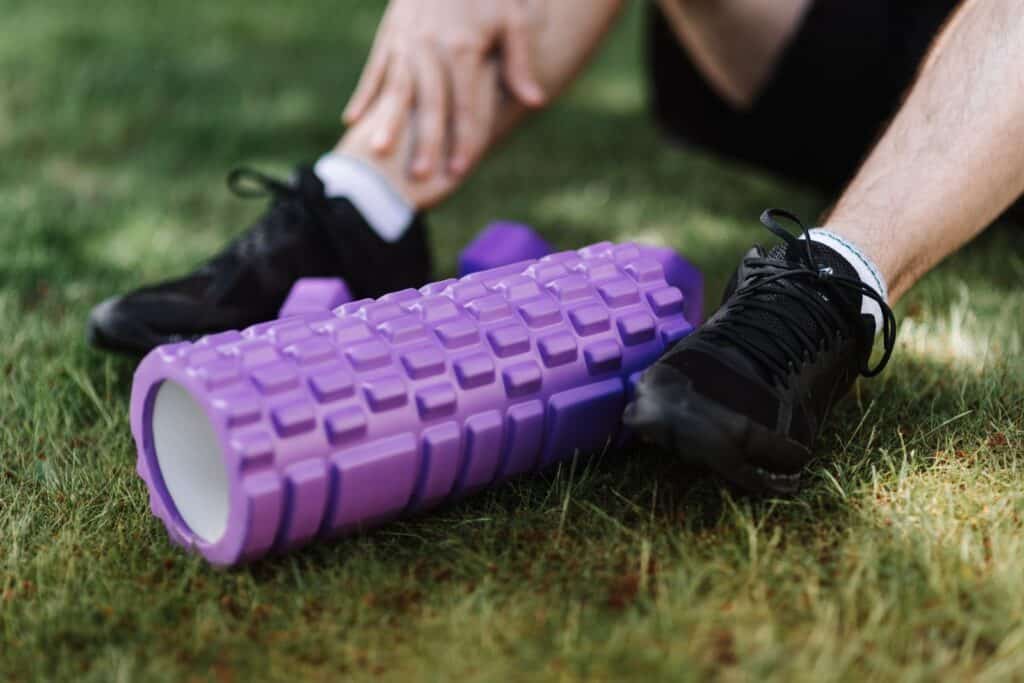
Research on speeding up recovery from DOMS is mixed, and many popular remedies have weaker evidence behind them than commonly assumed. Static stretching before or after a workout does not appear to meaningfully reduce soreness. Foam rolling and light massage have some modest evidence of short-term relief, largely through increased blood flow and reduced perceived tightness, though the effect tends to be temporary rather than accelerating the underlying repair process.
The factors with the most consistent supporting evidence are the basics: adequate sleep, sufficient protein intake to support tissue repair, and staying hydrated. None of these will eliminate soreness entirely after a genuinely new or intense stimulus, but they support the underlying recovery process the body is already running.
When Soreness Might Be Something Else
Typical DOMS is diffuse, affects the general muscle belly rather than a specific point, and improves steadily day by day. Pain that is sharp, localized to a joint or a specific spot rather than spread across the muscle, or that gets worse rather than better over the days following a workout, is not typical DOMS and is worth having evaluated. The same applies to very dark urine following extremely intense exercise, which can occasionally be a sign of a rare but serious condition called rhabdomyolysis and warrants prompt medical attention rather than being treated as ordinary soreness. This article is intended for general education and is not a substitute for personalized medical advice.
The soreness that follows a first leg day back after a long break is a specific kind of memorable. Stairs become a genuine strategic decision, and sitting down on a low chair requires a plan. That intensity almost always fades within a few sessions as the muscle adapts, which is exactly why the second and third workouts of a new routine rarely hurt as much as the first.
A Practical Way to Think About It Long-Term
Over months and years of consistent training, soreness tends to become a much less useful signal than it feels like early on. Tracking actual performance, weights lifted, reps completed, times, or distances, gives a far more reliable picture of whether training is working than how sore a particular session leaves someone feeling the next day. For most people, the goal is a training routine that can be sustained consistently, which usually means accepting that plenty of effective, well-executed workouts will not produce much soreness at all.
What Causes the Delay Before Soreness Sets In
Delayed onset muscle soreness gets its name specifically because of its timing, discomfort doesn’t appear immediately after exercise but rather develops over the following 24-72 hours, a delay explained by the underlying biology: the microscopic muscle fiber damage from unfamiliar or eccentric-heavy exercise triggers an inflammatory repair response, and it’s this repair process, involving immune cells and inflammatory signaling arriving at the damaged tissue, that produces the sensation of soreness, not the initial exercise-induced damage itself. This is why you can complete a hard workout and feel fine immediately afterward, only to wake up considerably more sore the following day or two, the biological process producing the discomfort is still unfolding well after the workout itself has ended.
Exercises emphasizing eccentric contraction, the lengthening phase of a muscle under load, like the lowering portion of a squat or downhill running, tend to produce more pronounced DOMS than concentric-dominant movement, since eccentric loading creates more of the specific type of muscle fiber microtrauma that triggers this repair-and-soreness process.
Normal Soreness vs. Signs Something Else Is Going On
Typical DOMS is diffuse across the muscle, symmetric if the exercise was bilateral, feels dull and achy rather than sharp, and gradually improves with gentle movement over roughly a week without any specific treatment being necessary. Pain that’s sharp or stabbing rather than dull, concentrated at a specific point rather than spread across the muscle, accompanied by visible swelling or bruising, or that worsens rather than gradually improves over several days suggests a genuine injury rather than typical DOMS, and warrants stopping the aggravating activity and seeking evaluation rather than assuming it will resolve the same way normal soreness does.
Reducing Severity Without Avoiding Exercise That Causes It
Since DOMS is a normal part of adapting to new or increased training stress, avoiding it entirely isn’t a realistic or even desirable goal, some degree of muscle fiber adaptation stress is part of how strength and endurance improve over time. Gradually progressing new exercises or increased training volume, rather than making dramatic jumps in intensity or unfamiliar movement patterns all at once, tends to produce less severe DOMS while still delivering training adaptation. The repeated bout effect, where the same exercise produces progressively less soreness with repeated exposure, means early, more pronounced soreness when starting a new program or exercise is a normal, temporary phase rather than something that will continue indefinitely with continued consistent training.
